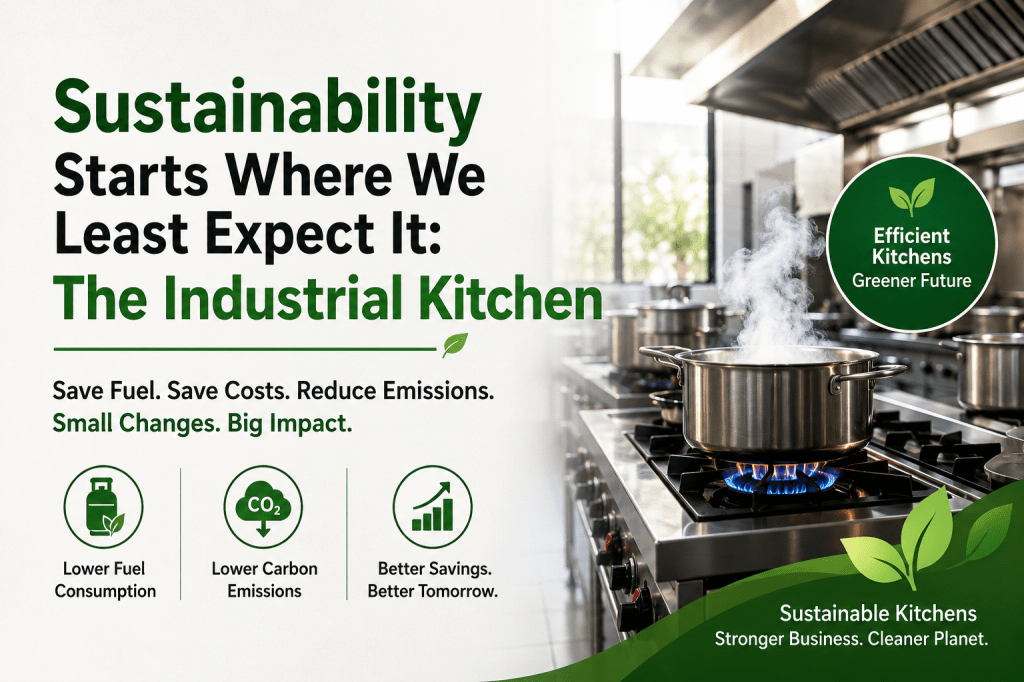
Sustainability – a word that has become increasingly prominent in boardrooms, conferences and business discussions across the globe.
There is no doubt that businesses are making genuine efforts to adopt more sustainable practices. From renewable energy and energy efficiency to waste reduction and carbon accounting, sustainability is steadily becoming an integral part of the way businesses operate. But there is one fundamental question that often remains unanswered:
Where do we start?
And when businesses do not know where to start, sustainability initiatives can sometimes remain limited to policies, reports and presentations rather than becoming measurable actions on the ground. At Metasis Technology Solutions, we believe sustainability does not always require a massive transformation. Sometimes, it starts with something as simple – and as overlooked – as an industrial kitchen.
The Industrial Kitchen: An Overlooked Source of Emissions
Large industries, factories, hospitals, institutions and corporate campuses often operate kitchens that serve hundreds or even thousands of employees every day.These kitchens can consume significant quantities of LPG.
Consider a hypothetical industrial facility with approximately 2,500 employees.
Assume its kitchen consumes around 150 kg of LPG per day. At an LPG cost of ₹125 per kg, the numbers quickly become significant:
| Parameter | Value |
| LPG consumption per day | 150 kg |
| LPG cost | ₹125/kg |
| Daily fuel cost | ₹18,750 |
| Monthly fuel cost – 26 working days | ₹4,87,500 |
| Annual fuel cost – 12 months | ₹58,50,000 |
That is nearly ₹58.5 lakh every year spent simply on cooking fuel.
For many organizations, this is a recurring operating expense that receives considerably less attention than other major energy-consuming systems. But the story does not end with the fuel bill. There is another number that deserves attention:
Carbon emissions.
150 kg of LPG Is More Than Just a Fuel Expense. When LPG is combusted, it releases carbon dioxide. Using an indicative emission factor of approximately 3.13 kg of CO₂ per kg of LPG, 150 kg of LPG consumption corresponds to approximately:
| Parameter | Value |
| LPG consumed per day | 150 kg |
| Approx. CO₂ generated per day | 470 kg |
| Approx. CO₂ generated per month | 12.2 tonnes |
| Approx. CO₂ generated per year | 146 tonnes |
The exact figure will vary depending on the emission factor and the organization’s chosen GHG accounting methodology. India’s Ministry of Environment has cited an LPG emission factor of 3.13 kg CO₂ per kg of LPG. From a GHG accounting perspective, fuel combustion in an organization’s own or controlled equipment is generally considered a Scope 1 emission. So, an industrial kitchen is not merely consuming fuel. It is also contributing directly to the organization’s operational carbon footprint.
The Question Is: Can We Reduce Both?
This is where energy efficiency becomes an important part of the sustainability conversation. What if the same kitchen could reduce its LPG consumption without compromising its cooking requirements?What if a relatively simple intervention could simultaneously deliver:
Lower fuel consumption + Lower operating cost + Lower carbon emissions
This is where radiant technology burners can play an important role. At Metasis Technology Solutions, we work with advanced radiant burner technology designed to improve heat transfer and combustion efficiency in commercial and industrial cooking applications. Depending on the application, cooking conditions and existing equipment, these burners can deliver significant reductions in LPG consumption.
Let’s Look at the Same Kitchen at 25% Savings:
Returning to our example of 150 kg of LPG consumption per day:
If the kitchen achieves a conservative 25% reduction in LPG consumption, the impact becomes measurable immediately.
| Parameter | Before | After 25% Reduction |
| Monthly LPG consumption | 3,900 kg | 2,925 kg |
| Monthly fuel cost | ₹4,87,500 | ₹3,65,625 |
| Monthly saving | — | ₹1,21,875 |
| Annual saving | — | ₹14,62,500 |
But the financial saving is only one side of the equation. The environmental impact is equally important.
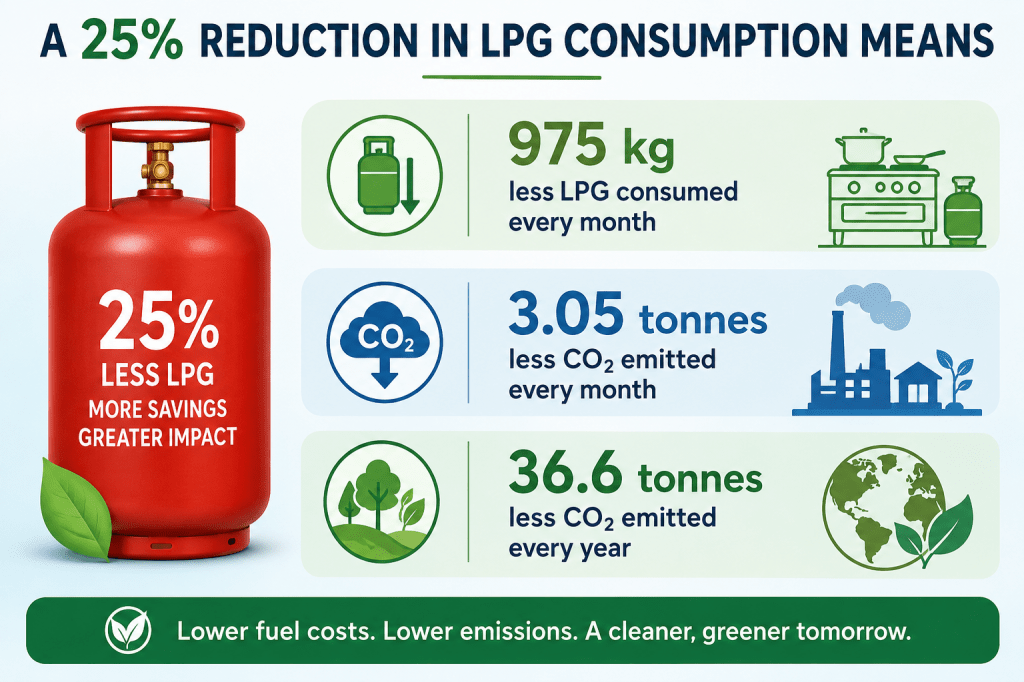
In other words, a relatively simple intervention in the kitchen can potentially help an organisation avoid more than 36 tonnes of CO₂ emissions every year, while simultaneously saving approximately ₹14.6 lakh annually under the assumptions above.
Sustainability Does Not Always Begin With a Large Project
When sustainability is discussed, organizations often think about solar power plants, electric vehicles, green buildings, renewable energy procurement or large-scale infrastructure investments. These initiatives are important. But sustainability can also begin with identifying the small, recurring sources of energy consumption that are hiding in plain sight. An industrial kitchen may not be the largest energy-consuming area of a facility.
But when a kitchen consumes hundreds of kilograms of LPG every day, even a modest improvement in efficiency can translate into meaningful financial and environmental benefits over an entire year. And unlike many sustainability initiatives that require significant capital expenditure, improving the efficiency of an existing cooking system can be a relatively straightforward operational intervention.
From Awareness to Action
India’s transition towards a greener economy requires businesses to look beyond conventional approaches to sustainability. For us at Metasis Technology Solutions, this is where technology and sustainability come together.
Our objective is simple:
Help industries consume less fuel, spend less on energy and reduce their carbon footprint – without compromising their core operations.
Because sustainability should not remain a discussion in a conference room. It should become a measurable result on the shop floor. And sometimes, that journey can begin in the kitchen. If your industrial or institutional kitchen consumes significant quantities of LPG, the first step is not necessarily to replace the entire system.
Start by measuring.
Understand your current consumption. Measure your cooking requirements. Evaluate your burner efficiency. Identify the opportunity for improvement. Then quantify the financial and carbon savings.
At Metasis Technology Solutions, we would be happy to work with industries looking to identify such opportunities and take practical steps towards reducing both their energy costs and carbon footprint.
Sustainability starts with action.
Act today for a more efficient and greener tomorrow!!
At Metasis Technology Solutions, we are committed to helping industries navigate the challenges of a rapidly evolving world. As a trusted technology partner, we deliver innovative solutions and advanced equipment that drive operational excellence, sustainability, and long-term growth.
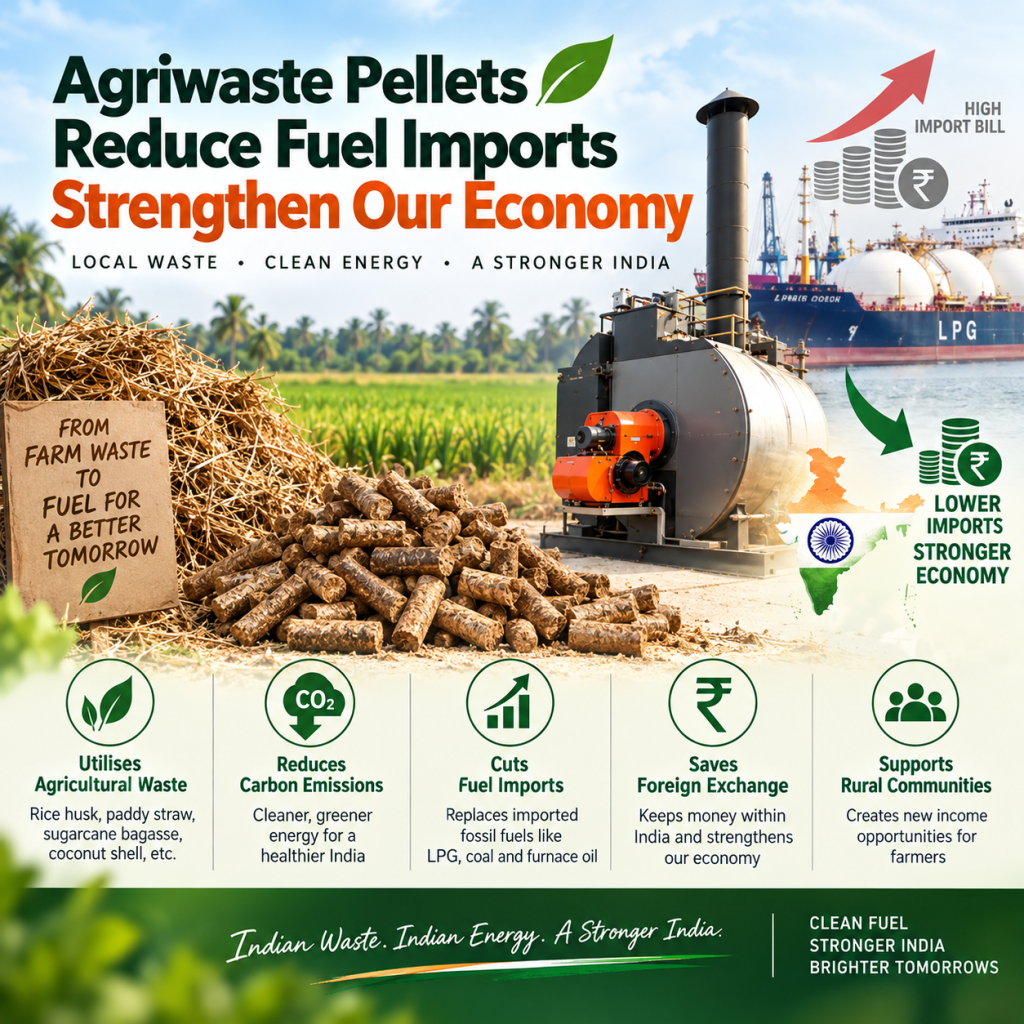
We offer Agri-waste pellet based heating solutions for your Boiler/ Industrial Heating Applications and Radiant Technology based Cookstove for Industrial Cooking / Restaurants.
To explore sustainable practices in your factory, reach out to us @ +919677119190/ cto@metasistech.in.
Innovating Today for a Sustainable Tomorrow.



Leave a Reply