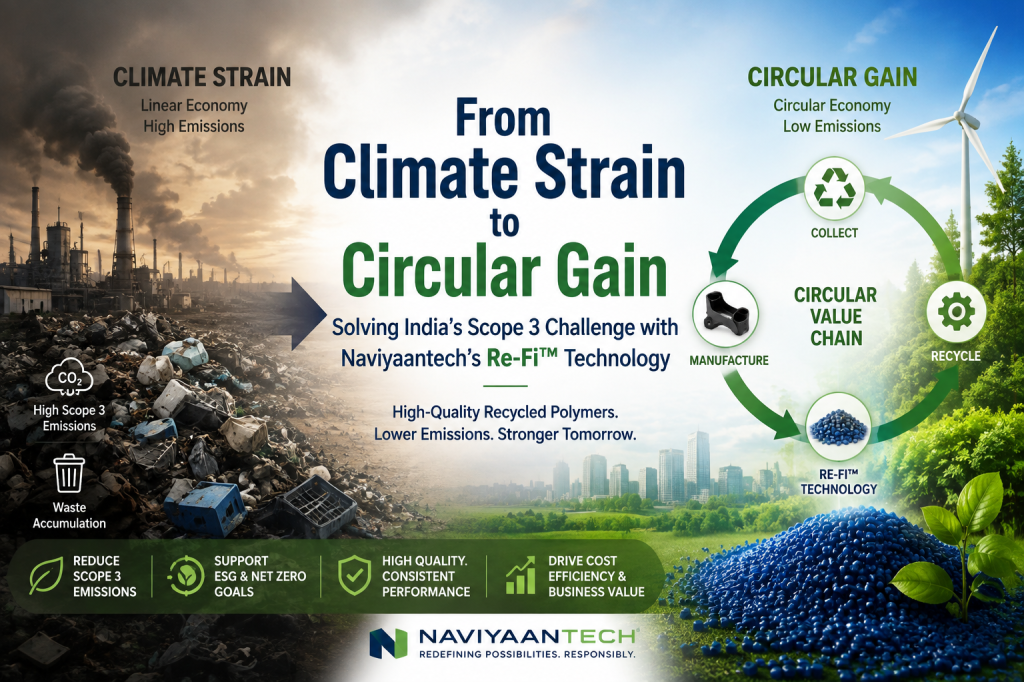
Across India, the climate reality is no longer a distant warning—it is unfolding right outside our windows. From unprecedented summer heatwaves reaching record highs to erratic, unpredictable monsoon patterns, extreme weather is testing the nation’s resilience.
These environmental shifts carry severe economic consequences. Searing temperatures and unpredictable rainfall strain agricultural output, driving up the costs of basic food supplies and essential commodities. As household budgets tighten, consumer spending contracts, creating a ripple effect that slows broader economic growth.
At the heart of this disruption lies our historical reliance on fossil fuels. Plastics—inherently derived from crude oil and petroleum processes—form the backbone of modern manufacturing. Yet, while Indian industry continues to import massive volumes of costly virgin polymers, tons of high-grade post-industrial plastic scrap are dumped daily into unorganized waste streams for throwaway prices.
This linear “take-make-dispose” model not only accelerates global carbon emissions but leaves Indian manufacturing exposed to severe supply chain and Scope 3 climate risks.
The Elephant in the Room: Scope 3 Emissions in Indian Manufacturing!!
For years, corporate sustainability focused primarily on Scope 1 (direct operational emissions) and Scope 2 (purchased electricity). However, up to 80% to 90% of a manufacturing company’s total carbon footprint resides in Scope 3—the indirect emissions tied to raw material extraction, supply chain logistics, and end-of-life waste processing.
With global regulations like the European Union’s Carbon Border Adjustment Mechanism (CBAM) coming into force and international buyers demanding strict Environmental, Social, and Governance (ESG) compliance, Indian manufacturers can no longer ignore Scope 3 metrics.
The Dilemma: Companies want to lower their Scope 3 footprint by using Recycled Plastics (RP), but the current market structure makes it nearly impossible for high-end engineering applications.
To bridge this gap, Naviyaantech is introducing a technical approach to industrial plastic scrap with its proprietary Re-Fi (Re-functionalization) Technology.
The Recycled Plastic Bottleneck: Traceability, Consistency, & Quality!!
If replacing virgin plastic with recycled alternatives is the obvious answer, why aren’t Indian OEMs doing it at scale?
The answer lies in the structural limitations of the current scrap and RP distribution ecosystem:
- Lack of Traceability: Traditional scrap dealers collect mixed, unverified plastics from various sources. Manufacturers have no visibility into thermal history, chemical contamination, or polymer degradation.
- Inconsistent Quality: A batch of recycled granules bought today will rarely match the mechanical properties of a batch bought next month, causing unpredictable shrinkage, cracking, or machine downtime during molding.
- Undefined Technical Specifications: High-performance manufacturing requires strict technical datasheets (tensile strength, impact resistance, thermal deflection). Commodity scrap distributors cannot provide these guarantees.
Because of these risks, engineering teams routinely reject recycled plastics for critical components, choosing instead to import expensive, virgin petroleum-based resins.
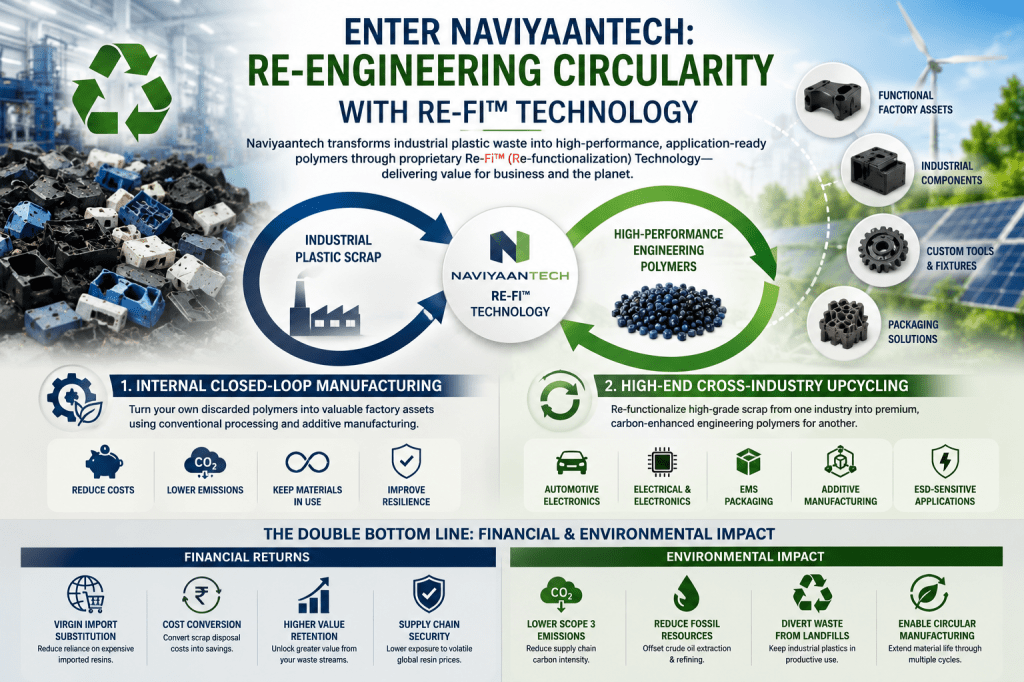
Enter Naviyaantech: Re-engineering Circularity with Re-Fi Technology.
To bridge this gap, Naviyaantech is introducing a technical approach to industrial plastic scrap with its proprietary Re-Fi (Re-functionalization) Technology.
Naviyaantech doesn’t operate as a standard scrap buyer or low-grade recycler. Founded by polymer engineers and additive manufacturing experts, the company upcycles post-industrial plastic scrap into certified, high-performance materials.
1. Internal Closed-Loop Manufacturing
Through conventional processing and 3D printing (Additive Manufacturing), Naviyaantech helps plants turn their own discarded polymers (such as HIPS, ABS, PC, and HDPE) back into functional factory assets:
2. High-End Cross-Industry Upcycling
Not all scrap needs to return to its original form. Naviyaantech’s Re-Fi process allows high-grade scrap from one industry—such as clean off-cuts from medical dialyzer casings or imported pharmaceutical API drums—to be re-functionalized into specialized, carbon-infused engineering polymers for another sector (like automotive electronics or EMS packaging).
Instead of being downcycled into low-value items or sent to landfills, the material is upgraded into a virgin-replacement material for high-end applications.
The Double Bottom Line: Financial & Environmental Impact
Adopting Naviyaantech’s Re-Fi circular model delivers clear strategic and commercial benefits:
1. Financial Returns :
- Virgin Import Substitution: Reduces reliance on expensive, foreign-sourced virgin resins by replacing them with upcycled local polymers.
- Cost Conversion: Converts scrap disposal expenses into significant savings on internal factory assets.
- Higher Scrap Value Retention: Enables companies to unlock hidden value from their post-industrial waste streams rather than liquidating scrap at distress prices.
2. Environmental Impact:
- Scope 3 Decarbonization: Provides verified carbon offset data, significantly lowering supply chain CO₂ intensity.
- Fossil Fuel Reduction: Every kilogram of re-functionalized polymer directly offsets the extraction and refining of crude oil needed for virgin plastic production.
- Landfill Diversion: Keeps clean industrial plastics in closed industrial loops indefinitely.
Ready to transform your industrial plastic scrap into a high-value asset?
NaviyaanTech is a Chennai-based materials company engineering recycled and functionalised polymers for Additive Manufacturing — across SLS, FGF, FFF, and photopolymer platforms. We work at the intersection of material science, sustainability, and industrial production.
Interested in exploring more? Click below
Naviyaantech LLP



Leave a Reply