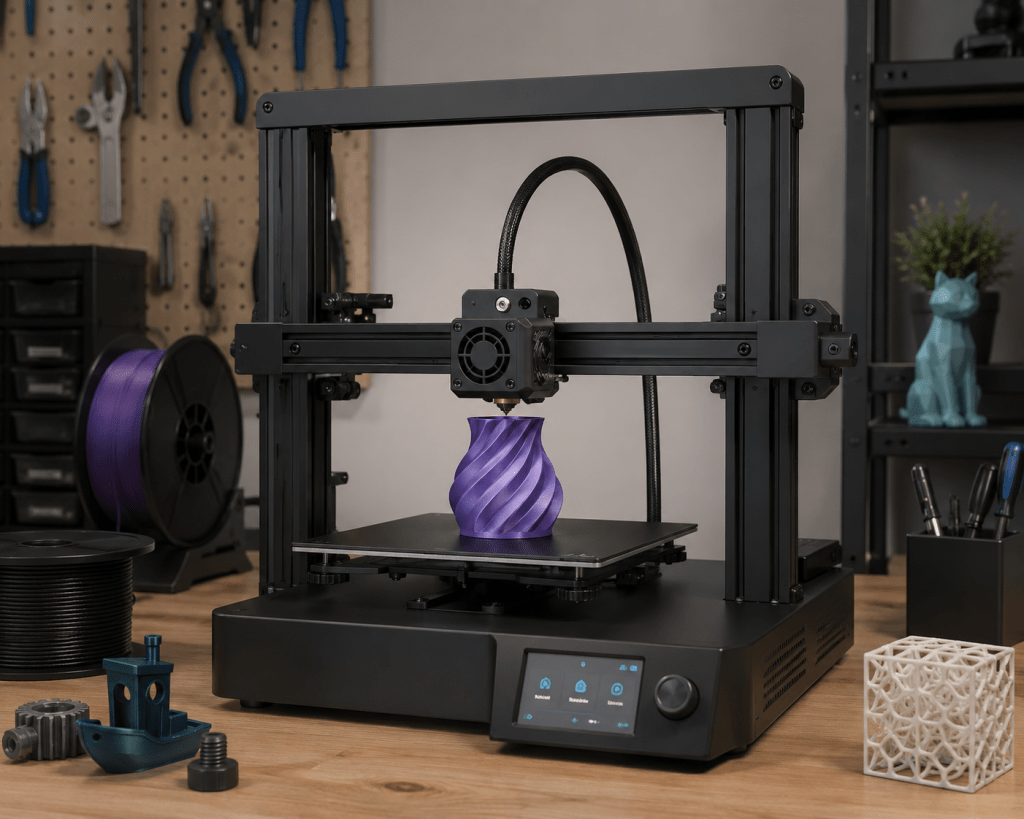
The machine is ready. The understanding isn’t.
Walk into most Indian 3D printing service bureaus operating SLS or MJF equipment and you’ll find a familiar scene: high-end industrial printers running prototype after prototype for design verification, fit-check models, and concept demonstrations — jobs that a ₹50,000 FFF machine could arguably handle.
Selective Laser Sintering: a technology built for end-use production, not just prototypes.
This isn’t a criticism of service providers. It’s a symptom of a deeper structural problem in how Indian industry perceives and deploys Additive Manufacturing.
SLS and MJF were engineered as end-use part production platforms — not as expensive rapid prototyping tools. The materials, tolerances, and isotropic mechanical properties these systems offer are meant to replace injection moulding runs, enable lightweighting, and produce functional hardware that goes into the field.
When these technologies are used predominantly for prototyping, service providers face a brutal cost-competition dynamic against FFF systems that can produce a “similar-looking” part at a fraction of the price. The client sees a shape. They don’t see the superior Z-axis strength, the chemical resistance, the heat deflection temperature, or the regulatory-grade traceability of the material.
The real cost of imported dependency..
The second structural wound runs deeper: India’s advanced AM ecosystem — SLS, MJF, SLA, DLP, LCD — is almost entirely dependent on imported materials.
100%
SLS PA-12 powder sourced from outside India
~3×
Cost premium vs equivalent industrial polymer
0
Domestic producers of application-grade SLS powder
When your material costs are fixed in Euros or USD and your clients are comparing you to domestic FFF providers quoting in rupees, the unit economics become extremely difficult. This imported dependency locks users into application profiles defined by foreign OEMs. You use the material the way the datasheet says. You don’t customise. You don’t engineer.
₹
Cost barrier
Imported powder pricing makes per-part costs uncompetitive against injection moulding at scale, killing volume opportunities.
🔒
Application lock-in
OEM-supplied materials define the use case. There is no room to tune for the actual application — aerospace, automotive, medical.
📉
Value perception gap
Clients compare output cost, not output capability. A PA-12 SLS part and a PLA FFF part look similar to a non-specialist buyer.
⚠️
Market stagnation
Without local material development, the Indian AM market cannot build the industrial depth that China, Germany, or the US have achieved.
“The same capability that lets SLS build a functional, load-bearing bracket for an automotive assembly is being used to make concept models that will never leave the conference table.”
The powder waste problem nobody talks about!!
Here is the question we want you to sit with.
You operate an SLS or MJF system. You run builds. After each build, a portion of the unfused powder surrounding your parts is recovered and refreshed with fresh powder at a prescribed ratio. Cycle after cycle, the recovered powder ages: its particle size distribution shifts, its melt flow changes, its surface chemistry oxidises.
After a certain number of refresh cycles, that powder is no longer printable to specification.
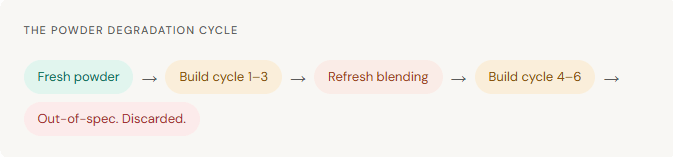
End-use SLS parts — the same material, once out of spec, has no recovery path today.
A mid-scale SLS service bureau running three to four builds per week can generate hundreds of kilograms of out-of-spec powder per year. Across India’s growing installed base, this is a material waste stream with no formal recycling pathway and no second life. There is no good global solution to this today.
And unlike polymer waste from injection moulding — where the material is well-characterised, clean, and abundant — SLS and MJF spent powder is a specialty polymer that most recyclers don’t know what to do with. The best option today: sell it as bulk scrap at near-zero value. Tonnes of highly engineered nylon, gone.
The SLA, DLP, and LCD problem is the same, differently expressed!!!
Photopolymer-based technologies carry their own version of this challenge. Resins are entirely imported. The range of available chemistries — castable, dental, engineering, flexible — is defined by foreign formulation houses. Indian service providers again become price-takers, not value-creators.
The dependency on import means that application development — the kind of experimentation needed to qualify a resin for a specific industrial use case — is nearly impossible at the service bureau level. You cannot reformulate a resin you didn’t make. This restricts the Indian AM ecosystem to being a service layer on top of foreign IP, foreign materials, and foreign application profiles.
NaviyaanTech · The gap we’re bridging
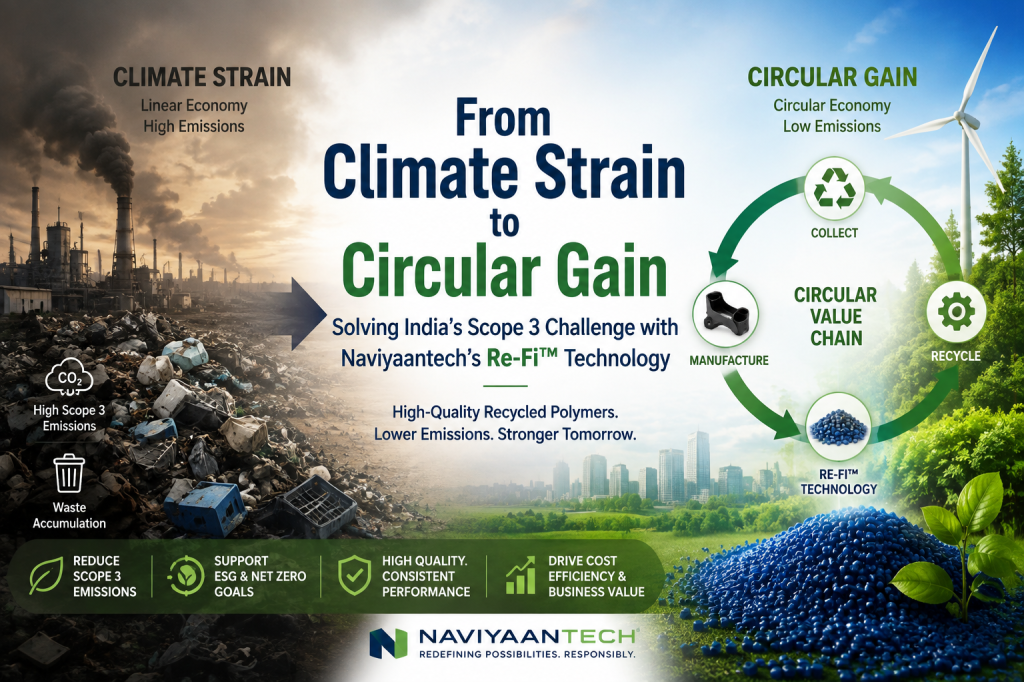
Materials built for Indian applications. Not imported assumptions.NaviyaanTech was formed on one conviction: that the Indian AM industry cannot reach its industrial potential until it controls its own material stack. Not by replicating foreign formulations — but by engineering materials for the actual applications and constraints of the Indian manufacturing ecosystem.We don't work with virgin base materials alone. We enhance, functionalize, and customise — adding nano-particle reinforcements, absorber systems, processing aids, and surface treatments — to extend what a material can do. A recycled polymer that performs at par with virgin in an FGF system. A filament engineered for a specific load case, not a generic datasheet.Critically, we are also building a pathway for the spent powder problem. By developing re-functionalization chemistries for out-of-spec SLS and MJF powders, we are working toward giving that material a second industrial life — closing the loop that currently has no closure anywhere in the world.

What the Indian AM industry needs to ask itself??
Are we selling the technology, or just the shape?
If your clients are choosing between your SLS part and an FFF part on the basis of cost alone, the market education has failed. The value of isotropic strength, consistent surface finish, and production-grade mechanical properties needs to be quantified and communicated — not assumed.
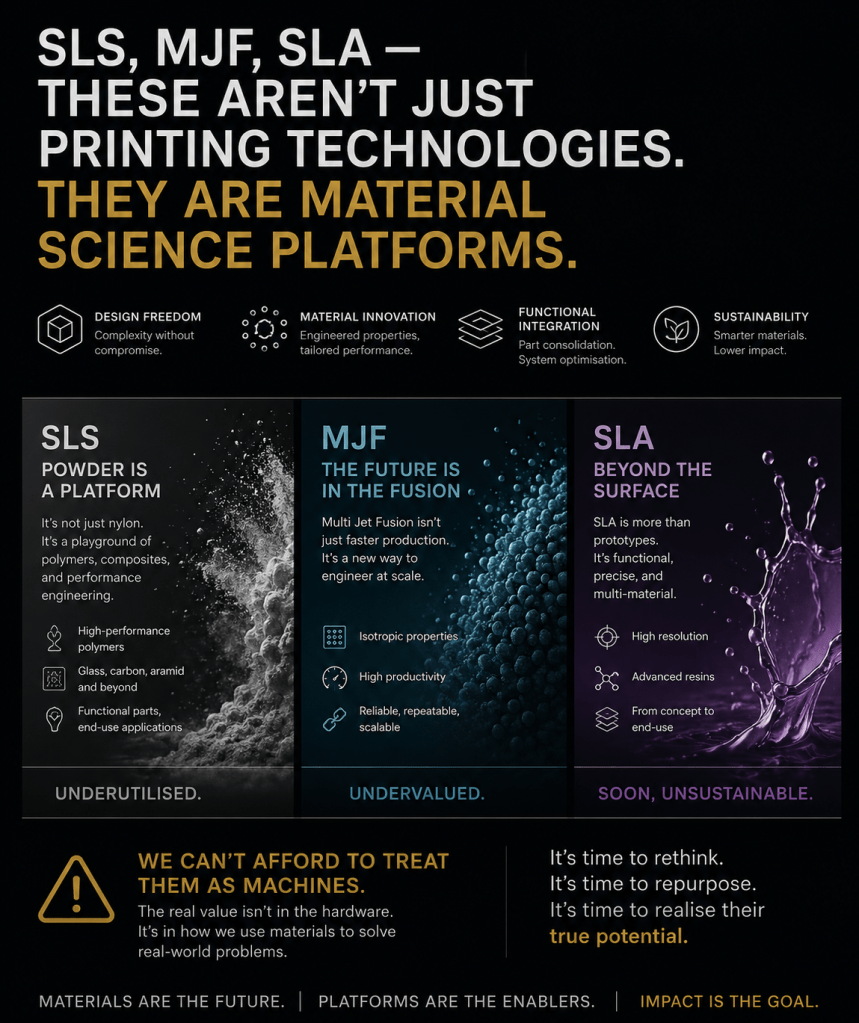
What is happening to your spent powder?
This is a cost question, a sustainability question, and increasingly a regulatory question as EPR frameworks in India begin to extend to industrial polymer waste. The tonnes of out-of-spec PA-12 or PA-11 sitting in your back room have a story — and that story needs a better ending than landfill or bulk scrap sale.
Are we building India’s AM industry, or renting capacity from foreign supply chains?
Every rupee spent on imported SLS powder is a rupee that doesn’t build domestic material capability. At the scale the Indian AM market needs to reach — to serve automotive, aerospace, defence, and healthcare — that dependency is a ceiling, not a foundation.
A closing thought!!!
The gap between what SLS and MJF can do and what they are being asked to do in India today is not a technology gap. It is a material understanding gap, a market education gap, and a supply chain gap. NaviyaanTech is working at all three levels — because without domestic material innovation, the Indian AM industry will remain exactly where it is: the world’s most capable import-dependent prototyping ecosystem, when it should be the world’s next industrial manufacturing platform.
A note on the Company!!!
NaviyaanTech is a Chennai-based materials company engineering recycled and functionalised polymers for Additive Manufacturing — across SLS, FGF, FFF, and photopolymer platforms. We work at the intersection of material science, sustainability, and industrial production.
Interested in exploring more? Click below


Leave a Reply