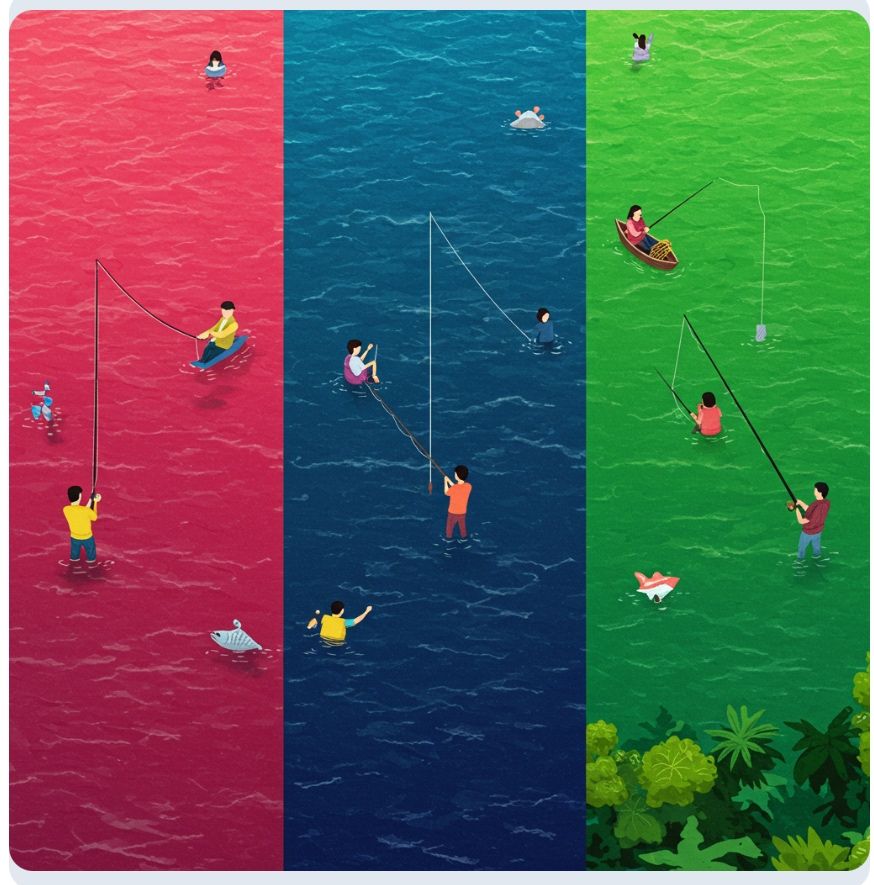
In the world of sales and business development, terms like “Red Ocean” and “Blue Ocean” strategies are as common as breathing. The Red Ocean, characterized by fierce competition in existing markets, often leads to bloody battles over market share. The Blue Ocean, on the other hand, advocates for creating uncontested market space, making the competition irrelevant.
While Blue Ocean strategies might appear cleaner and more innovative, focusing on solutions rather than just products, both ultimately share a similar trajectory. They are driven by transactional growth and product sales, often overlooking the profound social, environmental, and economic impacts on future generations and the planet’s delicate ecosystems.
The Unseen Cost of Growth:
For decades, the pursuit of industrial leadership and financial gains has led developed countries to offload technologies onto developing nations with minimal consideration for sustainability or potential environmental hazards. This unchecked growth, particularly over the last century, has paved a destructive path. Our volume-based manufacturing processes, while seemingly beneficial in the short term, are quietly acting like a pervasive cancer, eroding the very foundations of our planet without us fully realizing the extent of the damage.
Treating the Symptoms, Not the Disease:
Now, as the alarming diagnosis of climate change and environmental degradation becomes undeniable – the “cancer” that threatens our future generations – we’ve begun administering various “injections.” We see initiatives like:
- Resource efficiency: Using less to produce more.
- Renewable energy: Shifting away from fossil fuels.
- Pollution and waste reduction: Minimizing harmful byproducts.
- Green building: Designing environmentally friendly structures.
- Industrial process controls: Optimizing production for sustainability.
- Green IT: Making technology more energy-efficient.
These efforts, while commendable, often provide a false sense of security, making us believe we’ve effectively controlled the “Greenhouse Effect cancer” and averted total planetary destruction.

The Fragmented Approach: A Recipe for Side Effects:
The core problem lies in the fragmented approach. Each manufacturer, supplier, or technology developer operates within their own silo, interpreting the “cancer” and its “injection” based on their limited understanding. This leads to:
- Unintended side effects: A solution in one area might create new problems elsewhere. For example, focusing solely on reducing manufacturing waste might lead to increased energy consumption in another part of the supply chain if not holistically considered.
- Systemic leakages: Efforts in one part of the industrial ecosystem may not translate effectively across the entire value chain, allowing the underlying “cancer” to continue its spread. Imagine a company sourcing “green” materials but relying on highly polluting transportation methods.
- Lack of synergy: Without a unified vision, individual efforts, no matter how well-intentioned, struggle to create a truly impactful and sustainable change.
The cancer, despite our myriad injections, continues to grow.
Introducing the “Green Ocean” Strategy :
This is where the concept of the “Green Ocean” emerges – a globally accepted strategy that transcends the limitations of its predecessors. Like the vast, interconnected ocean itself, the Green Ocean demands a holistic perspective. It necessitates that every individual and entity involved in the lifecycle of a product or service – from the initial developer and manufacturer to the supplier, buyer, consumer, administrator, and controller – possesses an overarching view of its complete impact.
The Green Ocean isn’t just about minimizing harm; it’s about actively creating regenerative systems. It’s about recognizing that true growth isn’t measured solely by financial gains, but by the flourishing of societies, economies, and the natural world in harmony.


 navariTIE
Leave a comment